Arbitrary code isolation in unprivileged containers
Note: I started writing this post back in june 2025, but never had the guts to publish it. I think I am ready to share it, so here it is. Enjoy.
Abstract
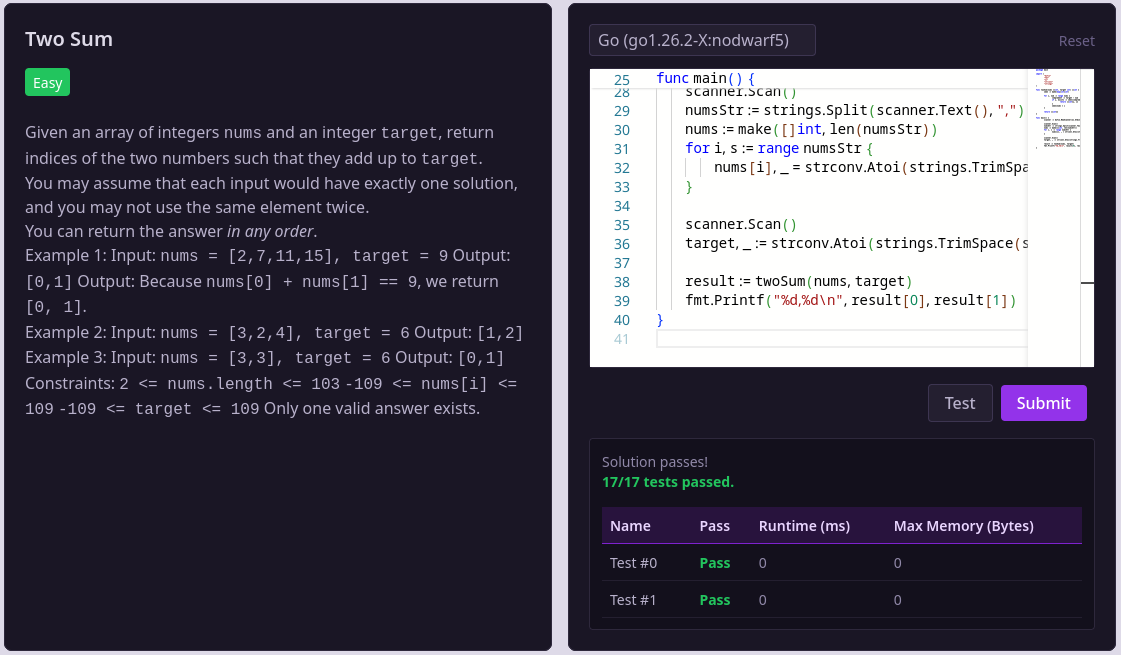
I challenged myself to make a LeetCode clone, a simple code challenge platform. I learned a great deal about containerization, namespaces, and other Linux kernel’s tools to manage and isolate program environments and resources.
I tried to build safe arbitrary-code execution inside unprivileged containers, learned where Linux/container isolation becomes a constraint, and ended up using WASM as the sandbox boundary.
Running arbitrary and possibly malicious code requires preemptive isolation and a declarative, zero-trust limit to a program’s access to operating system functions. The challenge becomes greater in Cloud Native environments like containers, which will often run unprivileged in the cloud, with a limited set of kernel capabilities.
The limited set of kernel capabilities within a container narrows solutions to a subset of userspace solutions, and WASM can be an almost perfect solution, but your mileage may vary.
Why run arbitrary code
There are products like Judge0 that reduce arbitrary code execution to a simple API, and that can be a perfectly valid approach, but constraints make engineering. I wanted the reference implementation and deployment of this project to be entirely self-sufficient. This constraint by itself is not an insurmountable challenge, but it’s the first half of a more extreme challenge.
Platforms like LeetCode or Hackerrank test the user’s skills and knowledge of data structures and algorithms, and favor the language-agnostic nature of these challenges by supporting a decently long list of programming languages for submissions. This is the second critical constraint, language agnostic code judging.
I found that it was deceptively difficult if you want your solution to run anywhere, with minimal configuration, but it’s also a worthwhile problem.
Why containers
Containers revolutionized computing as a replicable, declarative platform for packaging software. It is one of the most common ways to deploy modern applications. As a reasonable constraint, I decided that LameCode had to be shipped as a container, so that anyone could also make their own deployment and host their own code challenges. This does not mean that you cannot deploy LameCode natively, but it is not the focus of the reference implementation and deployment.
This ended up driving me down an interesting path of the Linux kernel and container
isolation. Spoiler: What happens when root is not a god user?
Why this is an issue
Containers themselves are isolating a group of processes and their resources from the host, but access to those tools is not nested in most fully managed environments or default configurations. That means when your application runs within a container and it needs to enforce similar control over child processes, it has much less power to do so.
How a container does it
Note: If you want to know more, there are many people that have already explained this better than I ever could.
I recommend this timeless talk by Liz Rice if you want a practical approach to understanding what makes Docker tick, but there is also Michael Kerrisk’s series on the user namespaces API if you are interested on the kernel API itself.
A container is a completely different approach to isolation compared to a virtual machine. A virtual machine seeks to emulate hardware, it can be very advanced but it sets clear boundaries of what hardware capabilities or features it exposes to whatever software (a full operating system usually) runs on the emulated machine.
A container never really runs software like an independent alien machine, it is only logically isolating processes within a separate nested filesystem and network stack, while controlling how much of the host machines’s resources it’s allowed to allocate and consume. There is only a single Linux kernel managing real hardware, but any number of software processes that can share or limit access to dependencies like libraries and compute resources with their children.
The tools a container relies on are:
- cgroups, for resource rationing. Limiting how much memory or CPU time a single process can consume.
- namespaces. Defining and managing the environment within the program runs. This enables Docker’s solution to dependency hell. Dependencies are nothing but files and services accessible from the right place at the right time for applications.
- Filesystem and Network overlays. Integral parts of any software stack that have to be either emulated or carefully managed (by Docker or any other container platform) to be used to create this new environment that can neither be abused or misused by the containerized process.
The tradeoff
Before executing a program withing these namespaces, the processes of the container lose access to kernel capabilities that they do not need. These restrictions enable true isolation from the host system, running the container’s processes natively while removing them any tools to wreak havoc on the host. You cannot mount new filesystems, cannot configure network interfaces or sniff packets, load or unload kernel modules.
You can think of these “capabilities” as a more fine-grained control system than just root/not-root, as it is described in the Docker security docs. Since all processes inside the container have their filesystem, network, and resources set up for them, this is not a problem for most applications.
You can add back these capabilities when you execute processes:
docker run --cap-add=SYS_ADMIN -it ubuntu:latest bashBut doing so opens the floodgates, so containers are rarely deployed “privileged”. In fully managed environments like AWS ECS or Sevalla your app will never run in containers with any capabilities added back on.
What this meant for LameCode
This meant tools like nsjail, firejail, and even docker itself were not an
option. These tools could be used to create viable and highly performant implementations
of LameCode, if cloud containers where not a necessary target. Running natively the
programs made by user’s would have been a great improvement.
Some ideas I played with when making LameCode where:
- GraalVM, which has interpreters for Python, JavaScript, Ruby, etc. and can sandbox them natively just like with WebAssembly. I still might add this as an extension.
- V8 Isolates: Like Cloudflare Workers, I could have used V8 Isolates to run JavaScript natively. Of course, that would only allow JS to run natively, anything else is still WebAssembly.
At the end of the day, there are many options, but they all trade speed, security, language support and the environment requirements.
| Technology | Core Mechanism | Unprivileged Container Compatibility |
|---|---|---|
| WebAssembly (Wasmtime) | Software Fault Isolation (SFI) via user-space compilation. | Runs entirely inside the host process’s standard virtual memory (mmap). Requires zero kernel privileges. |
| V8 Isolates | Process heap isolation within a single OS thread. | Spins up independent JS/TS runtime contexts entirely in user-space memory. |
| GraalVM (Truffle) | Managed language contexts inside a JVM process. | Enforces security boundaries via Java heap reference checks. Completely agnostic to OS privileges. |
| Seccomp-bpf Jailers | OS-level system call filtering. | Dropping new filters or creating isolated user namespaces typically requires CAP_SYS_ADMIN, which is stripped by default. |
| Linux MicroVMs (Firecracker) | Hardware virtualization via KVM hypervisor. | Strictly requires access to the host’s /dev/kvm device node, which is inaccessible without root/privileged access. |
| gVisor (runsc) | User-space kernel system call interception. | Virtualizing the guest OS environment requires low-level kernel hooks (ptrace) blocked in strict containers. |
Judging could be generalized into an API that can be extended to allow any number of methods, including third-party API’s, to do the execution of user solutions. I might do that later.
End result
I had a blast making the simple pipeline for checking known compilers and making them available to execute solutions. The LameCode experiment was a success, and I will later come back to give it some love.